


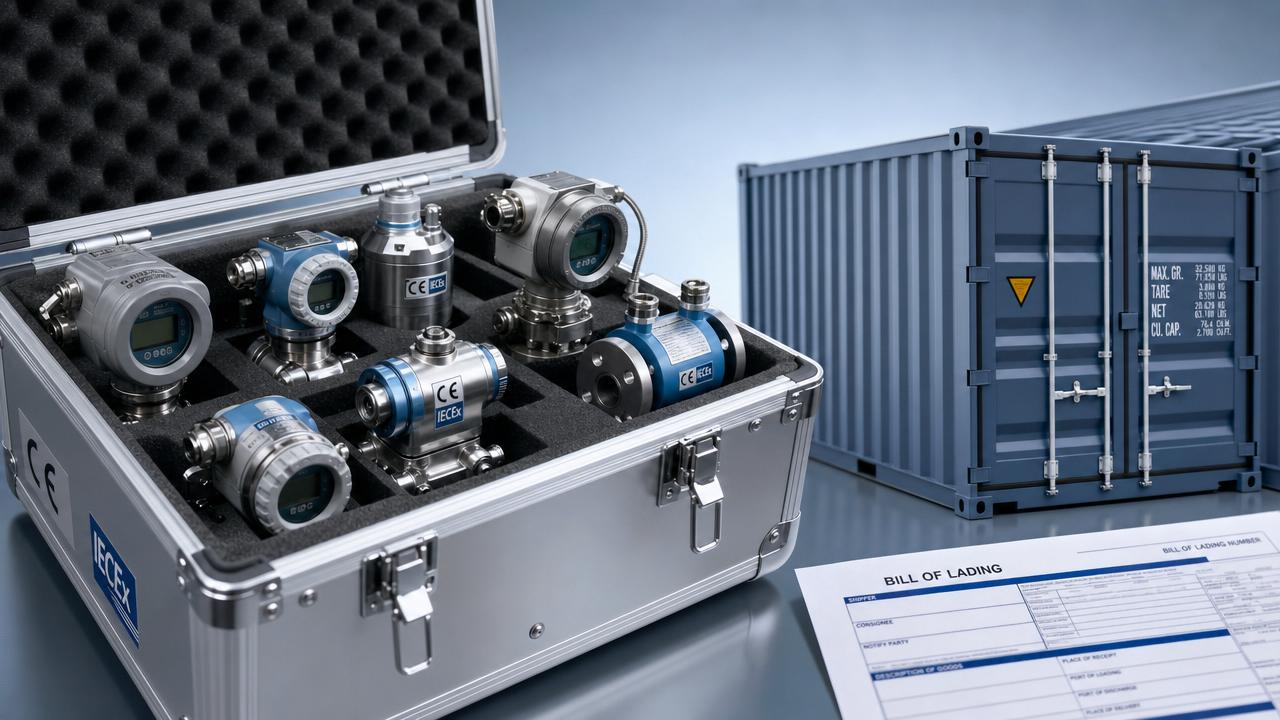
Shipping costs for instrument and meter exports from Shanghai and Ningbo ports rose 18% month-on-month in early May 2026, according to data from the Shanghai Shipping Exchange. This increase—driven by sustained Red Sea disruptions and consequent rerouting around the Cape of Good Hope—affects key destination markets including Rotterdam, Los Angeles, and Dubai. The extended transit time (7–10 days longer than usual) poses material implications for industries with tight delivery schedules, particularly pharmaceutical equipment integrators and power project system suppliers.
Event Overview
In early May 2026, standard container freight rates for instrument and meter exports from Shanghai and Ningbo ports to Rotterdam, Los Angeles, and Dubai increased by 18% compared to the previous month, per Shanghai Shipping Exchange data. The primary cause is the ongoing Red Sea crisis, which continues to restrict access to the Suez Canal route; approximately 90% of vessels are rerouting via the Cape of Good Hope. Combined with peak-season vessel capacity constraints, average maritime transit times have lengthened by 7–10 days.
Which Subsectors Are Affected
Direct Exporters (Instrument Manufacturers & OEMs)
These firms face higher landed costs and delayed revenue recognition due to extended shipping durations. For instruments sold under CIF or DAP terms, freight cost increases directly erode margins unless contractually adjustable. Delivery delays also risk contractual penalties or loss of repeat orders from time-sensitive overseas clients.
Project-Based System Integrators (e.g., Power, Pharma, Industrial Automation)
Integrators sourcing instruments for turnkey projects face cascading schedule risks. A 7–10-day delay in receiving calibrated flow meters, pressure transmitters, or analytical sensors can stall commissioning timelines—especially where equipment must be synchronized with civil works or third-party subsystems.
Supply Chain Service Providers (Freight Forwarders, Customs Brokers, Logistics Coordinators)
Forwarders report rising volatility in booking reliability and port congestion at transshipment hubs (e.g., Singapore, Colombo). Their operational planning—particularly for multimodal handoffs and customs clearance windows—must now accommodate wider transit time variance and tighter documentation deadlines for emergency air cargo options.
What Relevant Enterprises or Practitioners Should Monitor and Do Now
Track official updates on Suez Canal accessibility and BIMCO’s Red Sea Risk Assessment revisions
Current rerouting is based on safety advisories—not permanent infrastructure closure. Any shift toward partial Suez reopening or convoy-based transit could rapidly reset freight rate trajectories and lead times. Monitoring BIMCO and IMO guidance helps distinguish temporary contingency from structural change.
Review Incoterms clauses in active contracts—especially for high-priority shipments to EU, US, and Middle East markets
Analysis shows that FOB terms offer greater control over routing and carrier selection during volatility. Where existing contracts use CIF or C&F, assess feasibility of mutual amendment to include ‘red sea disruption’ force majeure triggers—or add air freight fallback provisions for critical SKUs.
Pre-qualify air freight alternatives for top-5 highest-revenue, shortest-lead-time instrument SKUs
Observably, air cargo capacity on Shanghai–Frankfurt and Ningbo–Dubai routes remains relatively stable. Pre-negotiating spot rates and handling protocols (e.g., EUDR-compliant packaging, IATA TI compliance for battery-powered devices) reduces decision latency when sea delays exceed contractual tolerance thresholds.
Flag delivery-sensitive customers proactively—and document revised ETAs in writing
From industry perspective, transparent communication—paired with documented evidence of external disruption (e.g., carrier-issued delay notices)—strengthens commercial goodwill and supports claims under insurance or trade credit policies. Avoid verbal-only ETA adjustments.
Editorial Perspective / Industry Observation
This freight surge is not merely a short-term cost fluctuation—it signals an inflection point in how instrument supply chains manage geopolitical transport risk. Analysis shows that the 18% cost jump coincides with a structural shift: rerouting is no longer occasional but institutionalized across major carriers’ published schedules. That makes it less a ‘temporary spike’ and more a new baseline for budgeting and contract design. Observably, forward-looking firms are beginning to treat Red Sea exposure as a permanent input variable—similar to fuel surcharge indices—not a one-off exception. Continued monitoring is warranted not for reversal, but for escalation: e.g., secondary impacts like port congestion in Southern Africa or insurance premium hikes for Cape-of-Good-Hope transits.
Concluding, this development underscores that logistics resilience for precision instrument exporters now hinges less on cost optimization and more on contractual agility and multimodal readiness. It is better understood not as a transient shock, but as a recalibration of global maritime risk assumptions—one requiring deliberate, documented adaptation rather than reactive firefighting.
Source: Shanghai Shipping Exchange (data reported for early May 2026). Note: Ongoing developments—including potential changes in canal access policy or carrier routing behavior—remain subject to observation beyond current public reporting.


") China's Instruments Rise: 7 Firms in Global Top 25 (2026)China's Instruments Rise: 7 firms enter 2026 Global Top 25 — Hikvision #4, United Imaging & SUPCON debut. Key insights for procurement, compliance & AI-integrated instrumentation.
China's Instruments Rise: 7 Firms in Global Top 25 (2026)China's Instruments Rise: 7 firms enter 2026 Global Top 25 — Hikvision #4, United Imaging & SUPCON debut. Key insights for procurement, compliance & AI-integrated instrumentation. German Brand & Design Council Opens Shanghai OfficeGerman Brand & Design Council opens Shanghai office to boost HMI design, CE-EMC/RED compliance & iF Award support for industrial instrument manufacturers and EU distributors.
 US Launches Third Sunset Review on Chinese Steel Grating AD/CVDUS third sunset review on Chinese steel grating AD/CVD impacts instrumentation exporters, metal fabricators & automation suppliers—act now to mitigate tariff risks.
 New Maritime Code Shifts No-Pickup Liability to ShippersNew Maritime Code shifts no-pickup liability to shippers—critical for instrumentation exporters. Learn how Article 93 reshapes risk, contracts & global logistics.
 Lianxun Instruments Q1 Net Profit Soars 515% on 1.6T Optical Module TestersLianxun Instruments' 1.6T optical module testers drive 515% Q1 net profit surge—discover how LX-1600 BERTs & eye analyzers are reshaping global AI infrastructure testing.
 Inovance Files for H-Share Listing to Raise $1.37B for Industrial AI Instruments and Edge ControllersInovance’s $1.37B H-share listing targets Industrial AI Instruments & Edge Controllers—watch for EU/US regulatory milestones, LoRa/MQTT/OPC UA field devices, and certification-driven market access.



Chat Online