


SABIC’s May 16, 2026 tender for instrumentation in its Jubail II 1.5-million-ton-per-year ethylene cracker marks the first known enforcement of simultaneous WirelessHART (IEC 62591) and Time-Sensitive Networking (TSN) protocol compatibility for field devices — a development with direct implications for industrial automation suppliers, field device manufacturers, and certification service providers serving the Middle East petrochemical sector.
Event Overview
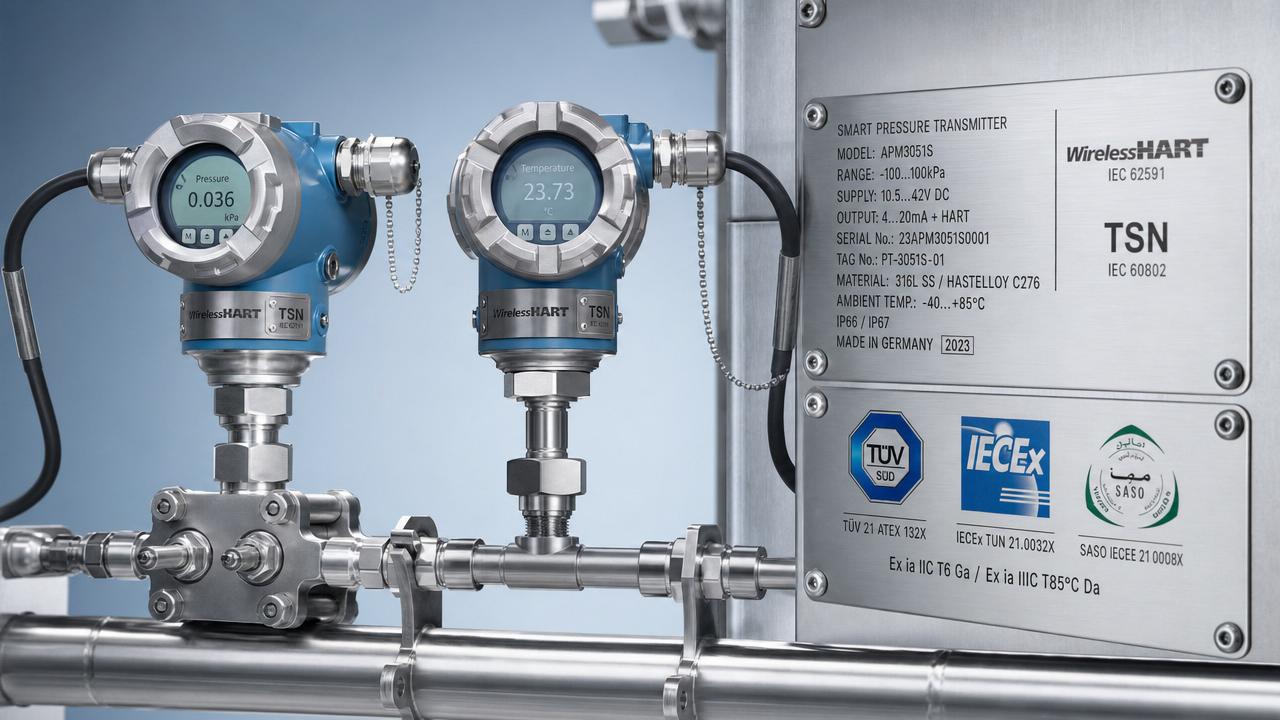
On May 16, 2026, Saudi Basic Industries Corporation (SABIC) issued tender document SABIC-ETP-2026-048 for Distributed Control System (DCS) and field instrumentation for its new ethylene cracking unit at Jubail II Industrial City. The tender explicitly requires all pressure transmitters, temperature transmitters, valve positioners, and analyzers to support both WirelessHART and TSN protocols concurrently. It further mandates dual certification: SASO IECEX (Saudi national explosion protection certification) and IECEx. Several Chinese manufacturers accredited by the ITEI HART Testing Laboratory have been pre-qualified.
Impact on Specific Industry Segments
Field Device Manufacturers
Manufacturers supplying pressure, temperature, and position feedback devices to Gulf-based EPCs or directly to SABIC must now validate dual-protocol firmware and hardware interoperability — not just conformance testing, but functional coexistence under real-time constraints. Impact manifests in product development timelines, firmware validation scope, and certification cost allocation.
Certification & Compliance Service Providers
Testing labs and certification bodies supporting SASO IECEX and IECEx approvals face increased demand for combined protocol + hazardous-area validation packages. The requirement for dual certification implies tighter coordination between functional safety, communication stack, and explosion protection test sequences — potentially extending approval lead times.
System Integrators & EPC Contractors
EPC firms bidding on SABIC or similar GCC projects must now assess vendor compliance beyond legacy HART or Foundation Fieldbus specifications. Integration planning must account for TSN timing guarantees alongside WirelessHART network management — affecting DCS configuration, wireless site surveys, and cybersecurity architecture for converged OT networks.
Export-Oriented Automation Suppliers
Suppliers targeting the Saudi and broader GCC markets must treat this tender as a de facto technical benchmark. While currently limited to one project, its inclusion in a SABIC ETP (Engineering, Tendering & Procurement) document signals alignment with Saudi Vision 2030’s digital infrastructure standards — raising expectations for future tenders across ADNOC, QP, and KPC.
What Relevant Enterprises or Practitioners Should Focus On Now
Monitor official SABIC clarification documents and addenda
Tender SABIC-ETP-2026-048 is active; any technical clarifications or amendments issued before bid submission deadlines will define implementation scope — particularly regarding TSN profile selection (e.g., IEEE 802.1Qbv, 802.1AS), WirelessHART network topology constraints, and fallback behavior during protocol handover.
Verify dual-protocol readiness of existing product lines — not just certifications
Pre-qualification status based on ITEI lab accreditation does not guarantee full system-level interoperability. Manufacturers should confirm whether their devices support concurrent WirelessHART and TSN operation (e.g., shared MAC layer, synchronized time distribution), not merely independent protocol stacks.
Prepare documentation for SASO IECEX + IECEx dual certification pathways
Applicants must align test reports, risk assessments, and quality system evidence to satisfy both SASO’s local requirements and IECEx’s international criteria — especially where TSN introduces new timing-related failure modes requiring updated functional safety analyses.
Engage early with SABIC-approved engineering partners on integration architecture
Given the novelty of converged WirelessHART+TSN deployments in large-scale hydrocarbon processing, collaboration with SABIC’s designated DCS integrators or system architects can clarify expectations on network segmentation, clock synchronization sources, and diagnostic data routing — reducing post-award rework risk.
Editorial Perspective / Industry Observation
Observably, this tender reflects a deliberate step toward converging wireless sensor networks with deterministic Ethernet — moving beyond pilot-scale trials into commercial-scale execution. Analysis shows it is not yet a broad regulatory mandate, but rather a project-specific technical specification elevated to procurement-level enforceability. From an industry perspective, it signals that major GCC operators are treating TSN readiness not as a future upgrade path, but as a baseline capability for new brownfield and greenfield automation investments. Current monitoring should focus less on whether TSN adoption is coming, and more on how quickly dual-protocol interoperability becomes a non-negotiable condition across regional tenders — especially those aligned with Saudi Industrial Strategy objectives.
This development is best understood not as an isolated procurement requirement, but as an early indicator of shifting technical baselines in Middle Eastern process automation. Its significance lies in formalizing protocol convergence as a contractual obligation — a shift that prioritizes architectural future-proofing over incremental upgrades. For stakeholders, the appropriate stance is measured attention: neither overestimating immediate rollout scale, nor underestimating its role in shaping upcoming technical specifications across the region’s largest petrochemical projects.
Source: SABIC Tender Document SABIC-ETP-2026-048 (issued May 16, 2026); public notice of pre-qualification for Chinese manufacturers via ITEI HART Testing Laboratory accreditation status. Ongoing observation required for tender addenda, bid award announcements, and potential replication in other SABIC or GCC operator tenders.


![]() Saudi SASO Rule to Reshape Imported Flow Meter TradeSaudi SASO Rule to Reshape Imported Flow Meter Trade: learn how new AI-assisted calibration and SASO-SmartCal data upload rules will impact Saudi customs clearance, exports, and compliance planning.
Saudi SASO Rule to Reshape Imported Flow Meter TradeSaudi SASO Rule to Reshape Imported Flow Meter Trade: learn how new AI-assisted calibration and SASO-SmartCal data upload rules will impact Saudi customs clearance, exports, and compliance planning. Saudi SASO Sets AI Flowmeter Calibration RuleSaudi SASO’s new AI flowmeter calibration rule changes import compliance for industrial flowmeters—see key impacts, deadlines, and practical steps for exporters.
 SASO Adds AI Calibration Rule for Flow MetersSASO’s new AI calibration rule for vortex, Coriolis and ultrasonic flow meters may affect Saudi imports, clearance timing and costs. Learn key impacts and compliance steps.
 SABIC Launches Instrumentation Tender with WirelessHART+TSN MandateWirelessHART+TSN instrumentation tender by SABIC — a breakthrough opportunity for certified instrument suppliers. Act now to meet IEC 60802 & 62591 compliance deadlines.
 SABIC Mandates Dual WirelessHART+TSN Support for New Ethylene Cracker InstrumentsSABIC mandates dual WirelessHART+TSN support for ethylene cracker instruments — a game-changing requirement for field devices, certification, and GCC automation suppliers.
 Saudi SASO Enforces Dual Ex-Certification for Pressure/Temperature TransmittersPressure/temperature transmitters for Saudi Arabia now require dual certification: IECEx + SASO SALEEM approval. Act now to avoid shipment delays and ensure GCC market access.




Chat Online