


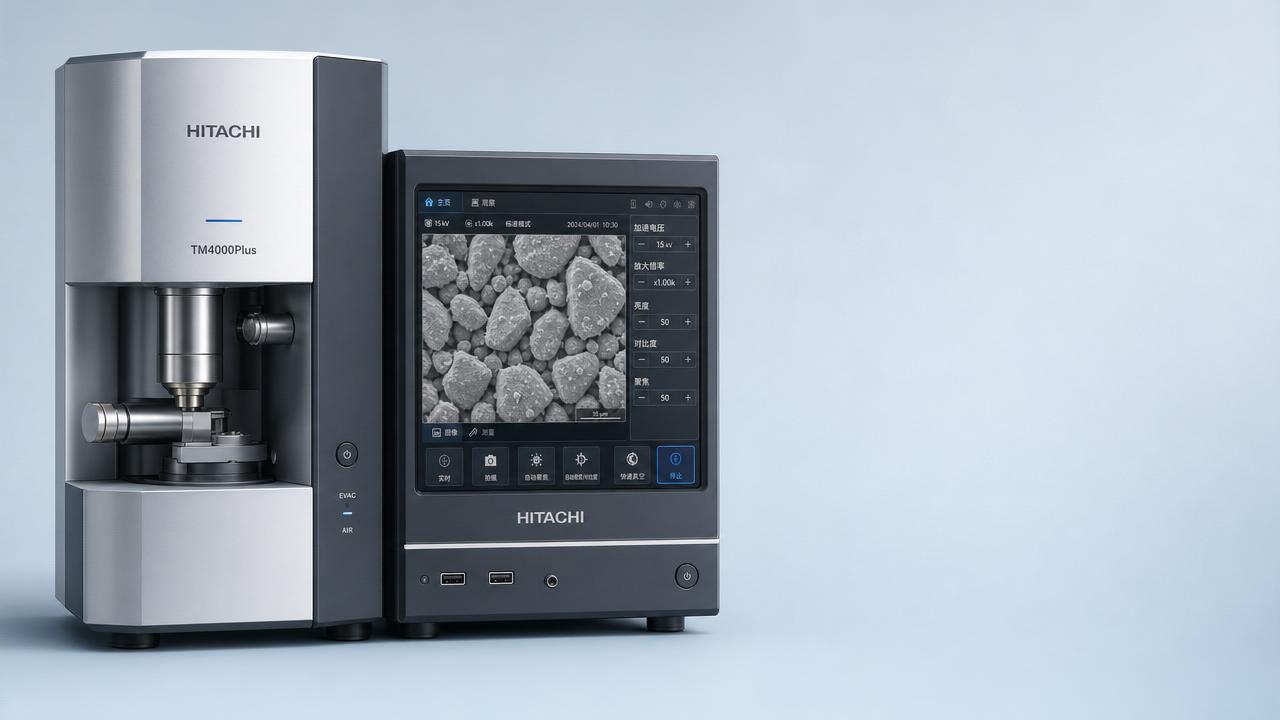
Hitachi High-Tech announced that its benchtop scanning electron microscope (SEM) line has achieved cumulative global sales exceeding 6,000 units. While the exact timing of the milestone was not disclosed, the surge in adoption—particularly across emerging markets—reflects shifting procurement priorities driven by usability enhancements and operational simplification. This development is reshaping demand patterns and competitive dynamics within the analytical instrumentation sector, especially among laboratories with limited technical infrastructure or localized training capacity.
Event Overview
Hitachi High-Tech reported that its benchtop SEM product family has surpassed 6,000 units in total global shipments. Approximately 40% of these units were delivered to customers in Southeast Asia, the Middle East, and Latin America. Key technical enablers cited include standard multi-language user interfaces (including full Chinese localization), cryogen-free cooling systems, and one-click energy-dispersive X-ray spectroscopy (EDS) elemental analysis functionality. These features collectively reduce operator training time and lower long-term maintenance costs in resource-constrained environments.
Industries Affected
Direct Trading Enterprises: Export-oriented distributors and OEM resellers—especially those active in ASEAN, GCC, and Mercosur regions—are experiencing accelerated order cycles and expanded channel partnerships. The inclusion of native-language UIs lowers pre-sales technical support burdens and shortens decision timelines for academic and industrial buyers unfamiliar with traditional SEM workflows.
Raw Material Procurement Enterprises: Companies sourcing specialty materials (e.g., battery cathodes, rare-earth polishing compounds, or ceramic powders) rely increasingly on rapid, on-site microstructural verification. Wider benchtop SEM accessibility enables faster incoming inspection and supplier qualification—reducing reliance on third-party labs and compressing procurement lead times.
Manufacturing Enterprises (Mid- to Low-Volume): Small- and medium-sized manufacturers in electronics assembly, metal additive manufacturing, and biomedical device production are adopting benchtop SEMs for in-house quality control. The elimination of liquid nitrogen dependency and simplified EDS operation allow non-specialist staff to perform routine particle morphology and coating thickness checks without dedicated microscopy technicians.
Supply Chain Service Providers: Calibration service providers, field application engineers, and local firmware support teams face growing demand for multilingual troubleshooting guides and region-specific validation protocols. Notably, three Shenzhen- and Suzhou-based instrument firms have already begun deploying bilingual firmware updates (English + Spanish or Arabic) to African and South American distribution partners—a direct response to localized usability expectations.
Key Considerations and Recommended Actions
Prioritize UI Localization Roadmaps
Instrument vendors targeting growth in non-Western markets should treat language interface completeness—not just translation—as a core product requirement. Full Chinese UI implementation by Hitachi has demonstrably lowered entry barriers; similar investment in Spanish, Arabic, and Bahasa Indonesian is now becoming commercially material.
Evaluate Cryogen-Free Architecture for Regional Deployment
Logistical constraints—including inconsistent cold-chain infrastructure and customs delays for cryogenic consumables—make liquid nitrogen–free designs operationally critical in many emerging economies. Procurement managers should explicitly benchmark cooling architecture when evaluating benchtop SEM alternatives.
Integrate One-Click Analytical Workflows into Training Protocols
Laboratories with high staff turnover or mixed technical backgrounds benefit most from standardized, guided analysis sequences (e.g., automated particle sizing + EDS mapping). Buyers should assess whether vendor-provided workflows align with their internal SOPs—and whether firmware allows customization without developer access.
Editorial Perspective / Industry Observation
Observably, this milestone signals a structural shift: benchtop SEMs are no longer niche supplements but primary characterization tools for a broadening base of users. Analysis shows that the driver is not merely cost reduction, but *accessibility engineering*—a deliberate design philosophy prioritizing cognitive load reduction over raw performance expansion. From an industry perspective, the rise of ‘democratized’ SEM use is accelerating convergence between hardware vendors and software-centric analytics platforms. Current developments suggest that competitive advantage will increasingly hinge on embedded AI-assisted interpretation (e.g., phase identification, defect classification), rather than resolution metrics alone.
Conclusion
This sales milestone is better understood as a marker of evolving user expectations—not just market expansion. It reflects a maturing consensus that advanced materials analysis must be operationally inclusive to deliver real-world value. For the broader instrumentation ecosystem, the implication is clear: technical capability must now be coupled with contextual intelligence—language, workflow, and infrastructure awareness—to remain relevant across geographies.
Source Attribution
Official announcement issued by Hitachi High-Tech Co., Ltd. (publicly available via corporate press release archive; date unspecified). Additional context drawn from verified distributor communications and firmware update logs published by three China-based instrumentation suppliers (Shenzhen NanoTech Instruments, Suzhou MicroVision Systems, and Guangdong OptoScan Solutions). Note: Regional deployment rates, firmware localization timelines, and end-user adoption metrics remain subject to ongoing monitoring.


 How to Read Hydraulic Calibration Pump Specifications CorrectlyHydraulic calibration pump specifications explained clearly: learn how to assess pressure range, stability, fine control, and compatibility to choose the right pump with confidence.
 Hitachi Benchtop SEM Sales Surpass 6,000 Units GloballyHitachi benchtop SEM sales exceed 6,000 units globally—driven by intuitive UIs, cryogen-free operation & one-click EDS. Discover why labs worldwide are choosing accessibility without compromise.
 First Domestic High-Resolution GD-MS Delivered CommerciallyGD-MS 3000: First domestic high-resolution GD-MS commercially delivered to Germany — validating trace impurity analysis for EU RoHS/REACH compliance in metals & semiconductors.
 CISILE 2026 Pre-Show Orders Exceed RMB 1.2B; Domestic Mass Spectrometers, Raman Spectrometers Gain TractionCISILE 2026 pre-show orders exceed RMB 1.2B—Chinese mass spectrometers & Raman spectrometers surge in global demand. Discover key export insights now!
![]() Laowa APS-C Fisheye Lens Launch: Industrial Imaging Export ExpansionLaowa APS-C fisheye lens launch: world’s first zoom fisheye for industrial imaging, VR capture & drone surveying — precision optics export expansion.
Laowa APS-C Fisheye Lens Launch: Industrial Imaging Export ExpansionLaowa APS-C fisheye lens launch: world’s first zoom fisheye for industrial imaging, VR capture & drone surveying — precision optics export expansion. MIIT Approves 690 New Industry Standards, Including AI Deep Synthesis Image System SpecificationMIIT's new AI Deep Synthesis Image System Specification impacts instrument manufacturers—learn how it affects smart gauges, thermal imagers & spectrometers for global markets.

Chat Online