


On 18 May 2026, the International Electrotechnical Commission (IEC) formally published IEC 61511-3:2026 — the first edition of the standard to mandate audit requirements for artificial intelligence (AI) algorithms embedded in Safety Instrumented Systems (SIS). This update significantly raises compliance expectations for safety-critical automation across high-hazard industries, driven by growing deployment of adaptive control logic and data-driven fault detection in process safety applications.
Event Overview
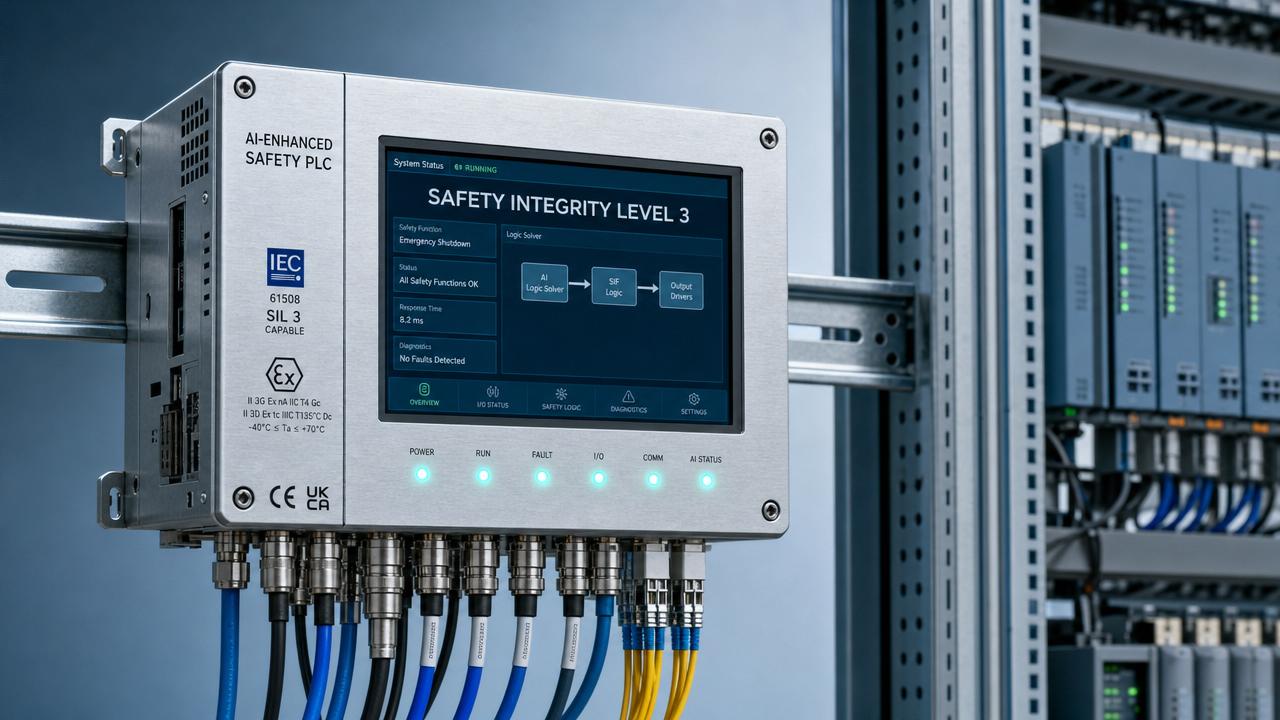
The International Electrotechnical Commission (IEC) released IEC 61511-3:2026 on 18 May 2026. The standard explicitly requires traceability, robustness, and failure mode analysis for AI-based components used within SIS. It applies to all new SIS designs and major modifications placed on the market after the transition deadline. Affected equipment includes intelligent final control elements, safety programmable logic controllers (PLCs), and safety-certified modules integrated into distributed control systems (DCS). Compliance is required globally; manufacturers exporting to IEC-aligned markets must complete certification adaptation by Q2 2027.
Industries and Stakeholders Impacted
Direct export-oriented enterprises: Companies supplying SIS hardware or software to international markets — especially those targeting EU, GCC, or APAC regions with strong IEC adoption — now face revised technical documentation, third-party verification, and algorithm validation protocols. Non-compliance may result in delayed type approvals, rejected tenders, or loss of CE/UKCA marking eligibility.
Raw material and component procurement firms: Suppliers of AI-accelerator chips, certified real-time operating systems (RTOS), or safety-certified machine learning inference libraries must now demonstrate alignment with IEC 61511-3’s audit criteria. Procurement specifications for such components are expected to evolve rapidly, requiring updated vendor qualification processes.
Equipment manufacturing firms: Producers of smart valve positioners, safety PLCs, and DCS-integrated safety modules must redesign verification workflows to include algorithm-level testing — including edge-case stress testing, bias evaluation, and explainability reporting. This introduces new cross-functional coordination between functional safety engineers and AI development teams.
Supply chain service providers: Certification bodies, test laboratories, and functional safety consultants must expand their competence scopes to cover AI-specific audit practices. Training programs, accreditation assessments, and audit checklists are undergoing revision — with implications for lead times and service pricing.
Key Focus Areas and Recommended Actions
Review existing SIS architecture for AI dependencies
Manufacturers should map all AI-enabled logic (e.g., anomaly detection models, adaptive trip thresholds, self-calibrating diagnostics) against Annex B of IEC 61511-3:2026. Identify gaps in traceability documentation, training data provenance, and failure mode coverage — particularly for black-box or continuously learning models.
Engage accredited certification bodies early
Given anticipated demand surges for AI-audit-capable assessors, firms planning certification cycles before Q2 2027 should initiate scoping discussions with notified bodies no later than Q4 2026. Priority should be given to those already developing AI-specific competence under IEC 61508-7:2024.
Update internal safety lifecycle documentation
Technical safety requirements specifications (TSRS), safety validation plans (SVP), and verification reports must now explicitly address AI algorithm behavior under degraded conditions, concept drift, and adversarial inputs. Legacy documents require version-controlled revision — not just annotation.
Evaluate supplier contracts for AI-related liability clauses
Procurement agreements with AI software vendors or chip suppliers should be reviewed for indemnification, update obligations, and audit rights. Where AI components are sourced as ‘black box’ services, contractual terms may need renegotiation to support end-to-end SIS audit readiness.
Editorial Perspective / Industry Observation
Observably, this revision signals a structural shift: functional safety regulation is moving beyond deterministic logic verification toward probabilistic and behavioral assurance. Analysis shows that while the standard does not prohibit AI use, it effectively raises the barrier to entry for startups or niche vendors lacking rigorous ML engineering governance. From an industry perspective, the requirement reflects growing regulator concern over opacity in adaptive safety logic — especially where human-in-the-loop intervention is impractical. Current more relevant question is not whether AI belongs in SIS, but how its decision boundaries can be operationally bounded and audited without undermining performance benefits.
Conclusion
This update marks a pivotal step in aligning safety standards with the reality of intelligent industrial systems. Rather than representing a blanket restriction, IEC 61511-3:2026 better serves as a framework for disciplined AI integration — one that prioritizes verifiability over novelty. For global suppliers, timely adaptation is less about technical feasibility and more about organizational readiness to bridge safety engineering and AI development disciplines.
Source Attribution
Official publication: International Electrotechnical Commission (IEC), IEC 61511-3:2026 Functional safety — Safety instrumented systems for the process industry sector — Part 3: Guidance for the determination of the required safety integrity levels, released 18 May 2026. Available via IEC Webstore.
Note: National adoptions (e.g., EN 61511-3 in Europe, GB/T 21109.3 in China) and transitional arrangements remain under review by respective national committees — continued monitoring advised.


 Policy Opens Easier B2B E-commerce Exports for InstrumentsPolicy Opens Easier B2B E-commerce Exports for Instruments: learn how the 9710/9810 pilot helps sensors, smart transmitters, and analyzers cut export friction and support faster trial orders.
 EU Plans Wider Curbs on High-Precision Sensor ExportsEU Plans Wider Curbs on High-Precision Sensor Exports: learn how proposed EU controls on laser interferometers, MEMS pressure sensors, and quantum gyroscopes could reshape compliance and supply chains.
 K-REACH Supply-Shortage Chemicals Exemption LaunchedK-REACH supply-shortage chemicals exemption launched—unlock fast-track market access for sensor chemical exporters to Korea’s smart instrumentation sector.
 EU REACH Adds 3 Substances: Smart Meter Exporters Must Update SVHC ScreeningSmart meter exporters: EU REACH now restricts 3 new substances—including a key epoxy curing agent in sensor encapsulation. Act now to update SVHC screening and ensure compliance by Nov 1, 2026.
 IEC 61511-3:2026 Introduces Mandatory AI Algorithm Audit for SISIEC 61511-3:2026 mandates AI algorithm audit for Safety Instrumented Systems (SIS) — discover compliance deadlines, impacted industries & actionable steps.
 IEC 61511-3:2026 Published: AI Algorithm Audit Added for SIS VerificationIEC 61511-3:2026 now mandates AI algorithm audit for SIS verification — critical for SIL2/SIL3 safety instruments in petrochemical, pharma & process automation.



Chat Online